

Many sales funnels look clean until the forecast misses. Then it becomes clear whether stages are truly distinct, whether probabilities are comparable, and whether the pipeline is based on real customer signals. A good funnel exposes those weaknesses early.
- Detail
- 12 sheets
- Detail
- XLSX
- Detail
- Advisor-reviewed
Sales Funnel Template
Excel structure for pipeline, forecast and sales reporting
Use the workbook as a practical sales funnel Excel example for pipeline and forecast: with stages, close probabilities, deal values, weighted pipeline, monthly forecast and KPI view.
- Excel workbook with example stages, probabilities and deal values
- Calculates weighted pipeline, monthly forecast and funnel KPIs
- Built as a template for funnel reporting and management reviews
Included modules
Format use
Best-fit package
Quick answer: how to build a sales funnel report
A sales funnel becomes useful for management when it does more than count contacts. It should translate active opportunities into a realistic view of future revenue.
- Define sales stages with observable customer signals.
- Set one centrally managed closing probability for each stage instead of letting every opportunity be estimated freely.
- Capture deal value, stage, owner, expected close date and revenue type for each opportunity.
- Calculate the weighted pipeline from deal value and stage probability.
- Review forecast, data quality and deviations in a fixed reporting cadence.
The examples below show how this becomes a practical sales report.
Sales funnel example: from opportunity value to monthly forecast
Many searches for sales funnel example, sales funnel template or sales pipeline Excel template are looking for a practical calculation logic rather than theory. This example shows how one deal moves from CRM or Excel into the management forecast.
- Stage: negotiation with confirmed decision-maker meeting
- Close probability: 50% based on the defined funnel stage
- Deal value: EUR 80,000 potential order intake
- Weighted pipeline: EUR 40,000 risk-adjusted forecast contribution
- Expected close month: August
- Management action: actively check decision criteria, procurement hurdles and the next customer meeting instead of leaving the deal passively in the forecast.
This turns sales funnel analysis into a steerable monthly forecast: open opportunities are not counted at full value, but with their probability and a clear management action.
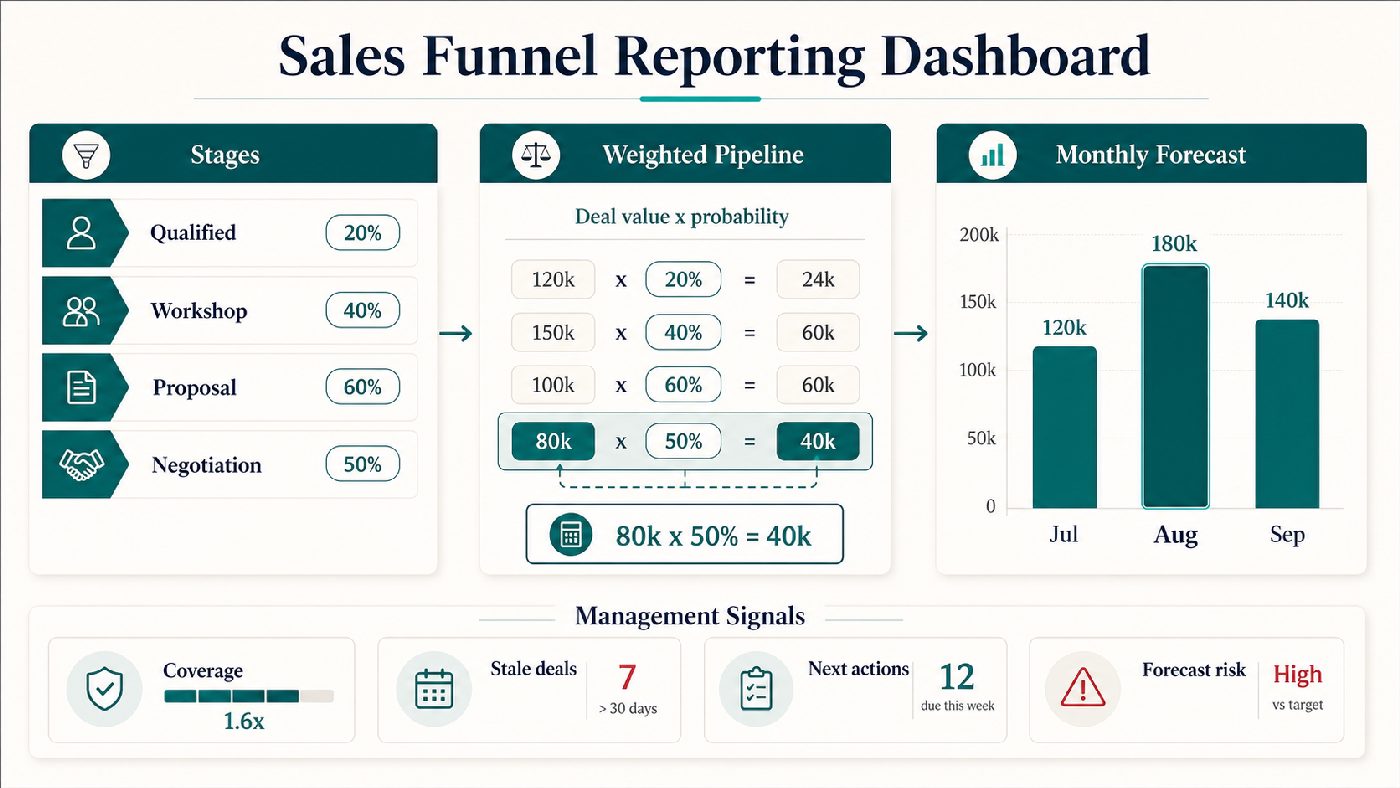
Accessible description and data
The dashboard visual shows sales funnel stages, stage probabilities, weighted pipeline, monthly forecast and management signals such as coverage, stale deals, next actions and forecast risk.
What is a sales funnel?
A sales funnel is a structured view of your active sales opportunities. It is also often called a pipeline or sales forecast. The funnel starts with potential customers and narrows because not every opportunity turns into an order.
For reliable sales reporting, two building blocks matter most: clear sales stages and realistic conversion rates by stage. The stage describes progress in the sales process. The conversion rate describes what share of opportunities in that stage typically turns into revenue.
Example: sales stages and conversion rates
The percentages are not universal benchmarks. They are a management model. What matters is that each stage is linked to a real customer signal.
| Sales stage | Customer signal | Probability | Management question |
|---|---|---|---|
| First contact reviewed | Company broadly fits the target customer profile | 5% | Is qualification worth the effort? |
| Qualified opportunity | Need, contact person and next step are clear | 20% | Is there a real buying problem? |
| Presentation / workshop | Solution and value have been discussed with relevant stakeholders | 40% | Is the business value understood? |
| Proposal sent | Proposal is available and commercial points are addressed | 60% | What is missing for a decision? |
| Negotiation / verbal commitment | Decision is expected soon | 80% | What risks remain around timing, price or procurement? |
| Won | Order is confirmed | 100% | When will revenue be recognized? |
How do you get from the sales funnel to revenue?
In addition to sales stage and conversion rate, you need deal value. The deal value describes the revenue that would be generated if the opportunity closed successfully.
If you multiply deal value by stage probability, you get expected revenue for that opportunity. Adding all expected revenue values gives you the weighted pipeline value. This is the bridge from sales funnel to forecast.
Expected revenue and weighted pipeline
The practical calculation has two steps: weight each opportunity, then add the weighted values into a pipeline view.
Useful for prioritizing active deals consistently.
Useful for forecast, management reporting and deviation analysis.
Example: calculate weighted pipeline
The example shows why the sum of all deal values is less important than the risk-weighted expected value.
| Opportunity | Stage | Deal value | Probability | Expected revenue |
|---|---|---|---|---|
| Manufacturing GmbH | Qualified opportunity | €100,000 | 20% | €20,000 |
| Utilities AG | Presentation / workshop | €75,000 | 40% | €30,000 |
| MedTech SE | Proposal sent | €90,000 | 60% | €54,000 |
| Software KG | First contact reviewed | €85,000 | 5% | €4,250 |
| Total | €350,000 | €108,250 |
The 30% rule: a rule of thumb for assessing your funnel
As a rough management rule of thumb, a weighted pipeline value of around 30% of open deal value can be a first plausibility check. In simple terms: in a basic funnel model, €3 of unweighted pipeline may translate into roughly €1 of expected revenue.
This rule does not replace analysis of your actual conversion rates. It helps identify obvious distortions: if weighted pipeline is very low, you may lack mature opportunities or your stages may be too conservative. If it is very high, the forecast may be too optimistic.
For target planning this means that €1m of unweighted pipeline is usually not enough to expect €1m in revenue. You need sufficient pipeline coverage and realistic stage weighting.
Download the free sales funnel template
Use a compact Excel structure for funnel stages, probabilities, weighted pipeline and monthly forecast logic. A practical next step if you want to turn this guide into a first report.
Practical tip: conversion rates are a management task
A typical problem in sales organizations is that some salespeople overestimate their opportunities, while others keep deals extremely conservative until just before closing. If every person sets probabilities freely, opportunities are no longer comparable.
That is why closing probabilities should not be individual gut feeling per deal. They should be centrally defined assumptions by sales stage. Management defines the logic, tests it against actual results and adjusts it when needed.
- Allow stage changes only when a clear customer signal exists.
- Compare stage probabilities regularly with actual win rates.
- Focus forecast conversations on risks, next steps and close dates, not only on percentages.
How to forecast revenue by month
In addition to expected revenue amount, timing matters. For this you need a realistic expected close date for each opportunity and, depending on your business model, logic for when revenue is actually recognized.
For one-off revenue, a December close can still have a major impact on the annual target. For recurring revenue, the number of remaining months in the year matters. For services, delivery capacity and project start timing may become decisive.
Example: monthly forecast from the pipeline
A simple forecast view groups weighted opportunities by expected close month and makes deviations from plan visible early.
| Month | Weighted pipeline | Planned revenue | Deviation | Management impulse |
|---|---|---|---|---|
| July | €42,000 | €50,000 | -€8,000 | Review mature opportunities and proposal risks |
| August | €31,000 | €45,000 | -€14,000 | Push additional qualified opportunities into the funnel |
| September | €68,000 | €60,000 | +€8,000 | Secure capacity and delivery readiness |
| October | €55,000 | €65,000 | -€10,000 | Refresh close dates and negotiation risks |
Sales funnel, marketing funnel and financial reporting: what is each for?
The three perspectives answer different management questions and should still connect consistently.
| Perspective | Time view | Data source | Typical management question |
|---|---|---|---|
| Marketing funnel | Upstream | Website, campaigns, lead scoring, MQL/SQL logic | Are enough qualified leads being created for sales? |
| Sales funnel | Forward-looking | CRM, opportunities, deal values, stages, close dates | Which revenue is realistically expected? |
| Financial reporting | Backward-looking | Accounting, ERP, invoicing, controlling | Which revenue has actually been realized? |
Which data your CRM or spreadsheet needs to provide
Sales funnel reporting is usually based on CRM data from systems such as Microsoft Dynamics, Salesforce, Pipedrive or HubSpot. In smaller companies, a well-structured Excel solution can be a useful starting point.
The strategic assumptions behind stages, target segments and close probabilities should come from the sales strategy. If forecast and actuals need to be connected regularly, also see the guide to German BWA reporting and the DATEV/BWA Reporting approach.
The tool matters less than data quality and consistency. For reliable reporting, you need at least these fields:
- Opportunity name and unique ID
- Customer or target customer
- Deal value and revenue type
- Current sales stage
- Stage probability or centrally defined stage logic
- Expected close date
- Responsible owner
- Next step and next activity date
- Status: open, won, lost or paused
- Timestamp or snapshot date for baselines and prior-year comparison
You can request a template aligned with these fields from the download section on this page.
Step-by-step guide: build sales reporting in 7 steps
- Define goals: determine which revenue lines, targets and management questions the report should cover.
- Define sales stages: describe each phase with clear entry criteria and customer signals.
- Set conversion rates: start with management assumptions and calibrate them later with actual results.
- Make data sources usable: check whether CRM, ERP, Excel and marketing data provide the required fields.
- Secure data quality: clear owners, mandatory fields and review dates prevent a beautiful but wrong funnel.
- Set up the reporting framework: build tables, dashboards or Power BI views for pipeline, forecast and deviations.
- Review and steer regularly: compare forecast with plan, prior year and actual revenue and derive specific actions.
It is better to start with a simple model that is maintained consistently than with a complex dashboard nobody trusts.
The structure and KPIs your sales report should contain
A sales report should not only show lists. It should enable decisions. The following KPIs form a robust starting structure.
| Area | KPI | Why it matters |
|---|---|---|
| Pipeline | Unweighted pipeline | Shows total open revenue potential. |
| Forecast | Weighted pipeline | Makes expected revenue comparable by stage. |
| Quality | Win rate by stage | Shows whether probabilities are realistic. |
| Timing | Forecast by month | Makes target deviations visible early. |
| Activity | Next step per opportunity | Prevents stuck deals without clear movement. |
| Hygiene | Opportunities without close date or owner | Highlights data gaps that make forecasts unreliable. |
| Steering | Plan-actual and forecast-plan deviation | Connects sales reporting with management action. |
How much effort should you expect?
A first sales funnel reporting prototype can often be created within a few days. A reliable management report, however, usually takes several weeks and sometimes months. The decisive factors are data quality, CRM discipline, interfaces and the availability of sales controlling or commercial operations resources.
If your CRM is clean, you can start faster. If opportunities, stages, deal values and close dates are inconsistent, most of the work lies in data cleanup, process clarification and alignment with the sales team.
Analyze one-off, recurring and project revenue correctly
Many companies have several revenue lines with different forecast logic. One-off product or license sales, recurring subscriptions and project-based services should not be forced into the same logic without reflection.
- One-off revenue depends heavily on close timing and individual deal size.
- Recurring revenue also depends on how many monthly values can still be realized within the business year.
- Services often depend on delivery capacity, project start timing and revenue recognition after delivery.
Separate these revenue lines in reporting when they matter for your business model. The forecast becomes less elegant, but much more useful for steering.
Baselines: compare your sales funnel with prior year and plan
A baseline is a historical reference point. It helps compare the current funnel with previous periods, for example the current September with the prior-year September. This is often more meaningful than a comparison with the previous month when your business is seasonal.
Many CRM systems primarily show the current state. You should therefore save regular snapshots, for example at month-end, quarter-end and year-end. These snapshots later show whether pipeline build, stage distribution and forecast quality have improved or deteriorated.
Common mistakes that make sales funnel reports useless
- Stages describe internal activity rather than real customer signals.
- Probabilities are estimated freely per opportunity and are not comparable.
- Close dates are not maintained and keep slipping every week.
- Weighted pipeline is misunderstood as guaranteed revenue.
- Marketing funnel, CRM forecast and financial reporting are not reconciled.
- The report shows numbers but no owners and no next steps.
A good funnel is therefore not just a reporting artifact. It is a management instrument: it creates transparency, prioritizes management attention and forces clear decisions.
Frequently asked questions about sales funnel templates, Excel and KPIs
What should a sales funnel Excel template contain?
A robust template contains stages, close probabilities, deal values, expected close months, owners, weighted pipeline, monthly forecast and KPI fields for conversion rate, pipeline coverage and forecast variance.
What does a good B2B sales funnel example show?
A good example does not only count contacts or leads. It shows real opportunities with customer signal, stage, value, probability, expected close month and a concrete management action.
Which KPIs belong in a sales funnel analysis?
Core KPIs include opportunity count by stage, stage conversion rate, weighted pipeline, pipeline coverage, expected order intake by month, win rate, sales cycle and forecast variance against plan or prior year.
What is funnel reporting?
Funnel reporting turns the sales process into a regular management view: which deals are where, which revenue is realistic, where customer signals are missing and which decisions the sales team needs now.
Conclusion: from sales funnel to steerable forecast
A sales funnel is valuable when it turns active opportunities into a reliable view of future revenue. For that you need clear stages, centrally managed conversion rates, clean data, monthly or weekly review routines and a connection to marketing and financial reporting.
The next sensible step is a simple but consistently maintained reporting model. Start with a template, test your assumptions against reality and professionalize the model once data quality and responsibilities are stable.
Use the matching template
Use the next step that fits your job: free sales funnel template, full Sales Toolkit or additional templates for sales strategy and sales concept work.

Mona Haas
Sales strategist for mid-market companies
Mona Haas is a dedicated sales strategist with a clear focus on mid-sized companies. Her passion lies in developing and implementing innovative sales concepts that drive growth and long-term success. With extensive experience in sales and a deep understanding of the challenges and opportunities facing the Mittelstand, Mona has a proven track record of increasing revenue and strengthening customer loyalty. Her ability to design tailored solutions aligned with each company’s specific needs makes her a valuable partner for any mid-sized business looking to optimize its sales strategy.
How would you rate this article?
Did this article help, or is something missing? Your feedback goes straight into improving our articles.
We review every response and use it to improve both content and reading flow.
Related reading

Sales Optimization: How to Improve B2B Sales Performance
Sales optimization is not a single project. It combines process clarity, leadership, data quality and disciplined execution. We help you achieve that.

Create a Sales Concept: Structure, Example and Template
Create a sales concept with structure, a practical example document, a free downloadable template and guidance on how to use it.

Create a Sales Strategy: Structure, Process and Example
Create a sales strategy with structure, process, a practical example and a free downloadable template for B2B teams.